
 ROI Calculator
 Book a demo














The terms ‘brand ambassador’ and ‘influencer’ are used interchangeably across the marketing industry but they describe fundamentally different relationships between a brand and the people who promote it. Understanding that distinction is not a matter of semantics. It determines how you recruit creators, how you structure agreements, how you measure success, and ultimately how much long-term value your creator programme delivers.
This guide defines both clearly, explains the practical differences, and helps marketing teams at DTC and eCommerce brands decide which model or which combination is right for their growth stage.
What Is a Brand Ambassador?
A brand ambassador is an individual typically a loyal customer, community member, or everyday creator who represents a brand on an ongoing basis. Brand ambassadors are recruited for the authenticity of their connection to a product or brand, not the size of their audience. They promote the brand through regular content creation, word-of-mouth referrals, social posts, and participation in structured marketing missions. In return, they receive rewards: free products, exclusive discounts, affiliate commissions, or cash payments.
The defining characteristic of an ambassador relationship is continuity. Ambassadors are not engaged for a single campaign. They are enrolled into a programme, given repeated assignments, and recognised over time. A brand building an ambassador programme is building a community of advocates one that grows in scale and depth the longer it is maintained.
Key characteristics of a brand ambassador:
- An existing customer or genuine fan of the brand
- Engaged on an ongoing basis, not a one-off campaign
- Typically operates at micro or nano scale (1,000–50,000 followers), but audience size is not the selection criterion
- Rewarded through a structured programme products, commissions, cash, or status
- Assigned specific missions: UGC creation, referral links, social posts, reviews, event attendance
- Tracked via a brand ambassador management platform
What Is an Influencer?
An influencer is a content creator with an established social media audience who is paid to produce promotional content for a brand. The influencer relationship is primarily transactional and campaign-based: a brand pays for a post, a reel, a story, or a series of these — and the agreement ends when the content is delivered.
Influencer selection is driven largely by audience size, demographic match, and engagement rate. A macro-influencer with 500,000 followers commands a significant fee for a single sponsored post. A micro-influencer with 20,000 followers commands less — but still operates within the same transactional model. The influencer may or may not use the product. The content is explicitly promotional. The relationship is finite.
Key characteristics of an influencer engagement:
- Selected based on audience size, niche, and engagement rate
- Engaged on a campaign-by-campaign basis
- Paid a flat fee or gifted product in exchange for specific content deliverables
- May have no prior relationship with the brand or product
- Content is typically disclosed as sponsored or gifted
- Managed through influencer marketing agencies or outreach platforms
Brand Ambassador vs. Influencer: A Direct Comparison
The following table summarises the key differences across the dimensions that matter most to a marketing team building a creator programme.
|
Brand Ambassador |
Influencer |
|
|
Relationship type |
Ongoing, community-based |
Transactional, campaign-based |
|
Selection criterion |
Brand affinity and authenticity |
Audience size and engagement rate |
|
Typical audience size |
Nano to micro (1K–50K) |
Micro to macro (10K–1M+) |
|
Content ownership |
Brand retains usage rights via programme terms |
Negotiated per campaign |
|
Payment model |
Commissions, rewards, products, or cash via programme |
Flat fee or gifted product per post |
|
Duration |
Long-term (months to years) |
Short-term (one campaign or post) |
|
Disclosure |
Varies by programme structure |
Typically required as sponsored |
|
Scalability |
Highly scalable via ambassador platform |
Costly to scale; each new influencer requires outreach |
|
ROI tracking |
Referral links, discount codes, performance dashboards |
Reach, impressions, and engagement estimates |
|
Best for |
Community building, word-of-mouth, sustainable growth |
Product launches, awareness campaigns, reach |
What Is the Difference Between a Brand Ambassador and an Affiliate?
A brand ambassador and an affiliate can overlap but they are not the same thing. An affiliate is defined entirely by their commercial relationship: they earn a commission when someone uses their unique referral link to make a purchase. There is no requirement for content creation, community participation, or brand alignment. Affiliates are compensated for conversions only.
A brand ambassador may operate with an affiliate component referral links and commission tracking are standard features of most ambassador programmes but the ambassador relationship is broader. Ambassadors create content, represent the brand in their community, complete missions, and engage with the brand over time. The commercial reward is one part of a fuller relationship.
In practical terms: an affiliate is motivated by commission. An ambassador is motivated by genuine affinity, community, and recognition with commission as one element of the reward structure. Both have a role in a modern DTC marketing strategy; they serve different purposes and attract different types of participants.
Why DTC Brands Are Moving Towards Ambassador Programmes
The influencer marketing model has matured and for many DTC brands, it has become expensive, inconsistent, and difficult to scale authentically. A macro-influencer post generates reach, but the audience knows it is paid. The content has a shelf life measured in days. The influencer moves on to the next brand. There is no compounding value.
Ambassador marketing works differently. A brand that recruits 200 loyal customers as ambassadors, equips them with a structured programme, and activates them consistently over 12 months is building something that compounds. Each ambassador generates UGC, referrals, and word-of-mouth that grows the brand’s credibility and customer base at a fraction of the cost of an equivalent influencer campaign.
The brands that have built the strongest communities Gymshark, Huel, Glossier, and others — did so by treating their most engaged customers as a marketing asset, not a target audience. That is the model ambassador marketing formalises and scales.
The specific advantages of ambassador programmes over traditional influencer campaigns:
- Lower cost per piece of content: ambassadors are rewarded with commissions and products rather than flat fees
- Higher authenticity: ambassadors are genuine users; their content reflects real product experience
- Compounding reach: an active ambassador community generates ongoing content, not a single campaign spike
- Performance tracking: referral codes and mission completion metrics provide precise ROI data
- Scalability: a well-structured ambassador platform can manage hundreds or thousands of ambassadors simultaneously
- Community value: ambassadors become part of the brand’s identity, not just its distribution network
When Should You Use Influencers vs. Brand Ambassadors?
The two models are not mutually exclusive. Most mature DTC marketing strategies use both — but at different stages and for different objectives.
Use influencer marketing when:
- You are launching a new product and need immediate, wide awareness
- You are entering a new market or demographic and need credibility quickly
- You have a specific campaign with defined creative requirements and a short timeline
- You are willing to pay for guaranteed reach to a specific audience
- You have the budget to manage multiple campaign relationships concurrently
Use ambassador marketing when:
- You have an existing customer base with genuine product advocates you want to activate
- You want to build a sustainable, scalable word-of-mouth channel over time
- You need a consistent pipeline of authentic UGC for organic and paid use
- You want performance-linked rewards rather than flat upfront fees
- You are building brand identity through community, not just awareness through reach
- You are scaling a creator programme to hundreds of participants simultaneously
How to Build a Brand Ambassador Programme for a DTC Brand
Building an ambassador programme from scratch involves five core steps.
1. Define your ambassador profile
Identify the type of customer or creator you want to recruit. For most DTC brands, this is an existing buyer with genuine product affinity, a social presence, and a willingness to create content. Audience size is secondary to authenticity and engagement quality.
2. Build your recruitment infrastructure
Create an application form or landing page that explains the programme, the rewards, and what participation involves. Use your existing customer base, email list, and social channels as the primary recruitment funnel.
3. Structure your missions
Define what you want ambassadors to do: UGC creation, referral posting, product reviews, event attendance, community engagement. Each mission should have clear requirements, a deadline, and a defined reward.
4. Set up your reward and payment model
Decide how ambassadors are compensated commissions, free product, exclusive discounts, cash, or status tiers. Automate where possible. Manual payment processes break down at scale.
5. Manage and track performance with a dedicated platform
A brand ambassador management platform allows you to recruit, onboard, assign missions, track content and referral performance, and process rewards from a single dashboard. This is what makes a programme scalable beyond a handful of participants.
Frequently Asked Questions
What is the difference between a brand ambassador and an influencer?
A brand ambassador is an ongoing advocate typically a loyal customer who represents a brand consistently over time through content, referrals, and community participation. An influencer is a content creator engaged on a campaign basis, paid to produce specific promotional content for a defined fee. The key distinctions are relationship length (ongoing vs. campaign), selection criteria (brand affinity vs. audience size), and compensation model (commissions and rewards vs. flat fees).
Can someone be both a brand ambassador and an influencer?
Yes. A creator with a significant social following who is also a genuine product advocate and enrolled in an ambassador programme operates as both. In practice, the distinction is more relevant for programme design than for how an individual creator describes themselves. DTC brands often find that their most effective ambassadors started as organic advocates who were later formalised into the programme.
What is the difference between a brand ambassador and an affiliate?
An affiliate earns commission on sales generated through their referral link, with no obligation to create content or represent the brand in any other way. A brand ambassador typically includes an affiliate component a referral link and commission structure but also creates content, completes missions, and participates in the brand community. The ambassador relationship is broader; the affiliate relationship is purely commercial.
How much does it cost to run a brand ambassador programme?
The cost depends on programme scale, reward structure, and the platform used to manage it. Ambassador programmes are generally significantly more cost-efficient than traditional influencer campaigns. Rewards are typically performance-linked (commissions on sales, free product) rather than flat fees, which means spend scales with results. A brand ambassador management platform typically costs between £300 and £1,500 per month depending on the number of ambassadors and features required.
What software do brands use to manage brand ambassador programmes?
Brands managing ambassador programmes at scale use dedicated brand ambassador management platforms. These platforms handle recruitment, onboarding, mission assignment, content tracking, referral attribution, and reward payments from a single dashboard. Club.co is a brand ambassador platform built specifically for DTC and eCommerce brands, enabling teams to manage communities of ambassadors, micro-influencers, affiliates, and UGC creators in one place.
How do I recruit brand ambassadors for my DTC brand?
The most effective recruitment source is your existing customer base. Identify buyers who have already posted about your brand organically, left strong reviews, or engaged with your social content. Reach out directly, or build an application landing page promoted through email and social channels. Define the programme benefits clearly: what ambassadors receive, what they are asked to do, and how performance is rewarded.
How do I measure the ROI of a brand ambassador programme?
ROI is measured through a combination of referral tracking (unique discount codes and affiliate links), content value (the number and quality of UGC assets generated), sales attribution (orders directly linked to ambassador activity), and engagement metrics (reach, clicks, and conversions from ambassador content). A brand ambassador platform provides dashboards that surface these metrics at both the programme and individual ambassador level.
Build Your Brand Ambassador Programme with Club
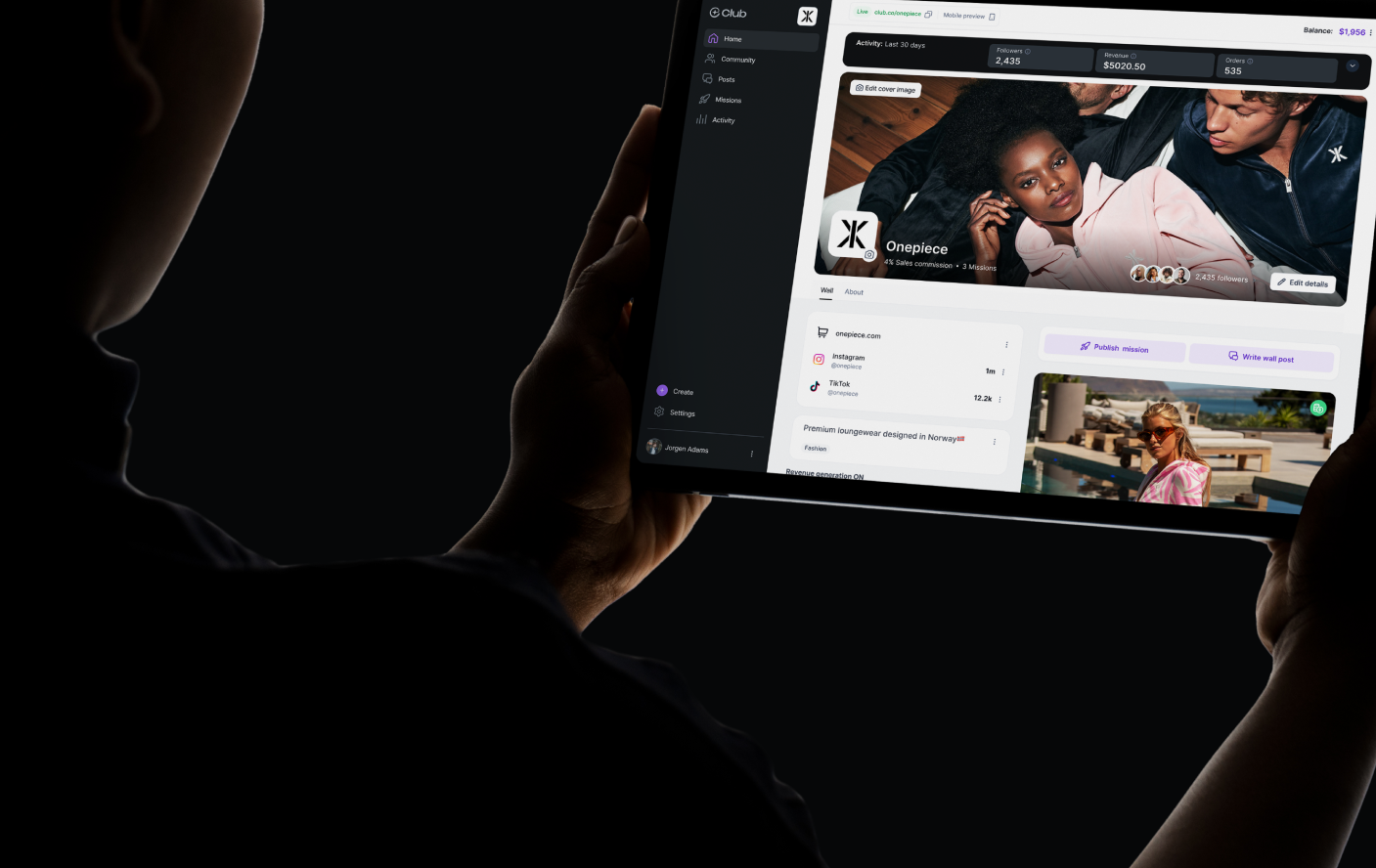
Club is a brand ambassador platform built for DTC and eCommerce brands. It enables marketing teams to recruit customers and creators as brand ambassadors, assign them missions, track content and sales performance, and automate reward payments all from one platform.
Brands including Samsung, Celsius, Daniel Wellington, and Fabletics use Club to manage ambassador communities at scale.









.svg)